Showing posts with label Mathematics IB. Show all posts

Mean Value Theorems

Leave a Comment
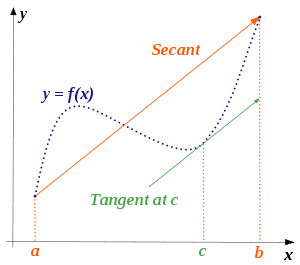
In mathematics, the mean value theorem states, roughly: that given a planar arc between two endpoints, there is at least one point at which the tangent to the arc is parallel to the secant through its endpoints.

The theorem is used to prove global statements about a function on an interval starting from local hypotheses about derivatives at points of the interval.

More precisely, if a function f is continuous on the closed interval [a, b], where a < b, and differentiable on the open interval (a, b), then there exists a point c in (a, b) such that

A special case of this theorem was first described by Parameshvara (1370–1460) from the Kerala school of astronomy and mathematics in his commentaries on Govindasvāmi and Bhaskara II.The mean value theorem in its modern form was later stated by Augustin Louis Cauchy (1789–1857). It is one of the most important results in differential calculus, as well as one of the most important theorems in mathematical analysis, and is useful in proving the fundamental theorem of calculus. The mean value theorem follows from the more specific statement of Rolle's theorem, and can be used to prove the more general statement of Taylor's theorem (with Lagrange form of the remainder term).


Read More...

Maxima and Minima - 2

Leave a Comment

A real-valued function f defined on a domain X has a global (or absolute) maximum point at x∗ if f(x∗) ≥ f(x) for all x in X. Similarly, the function has a global (or absolute) minimum point at x∗ if f(x∗) ≤ f(x) for all x in X. The value of the function at a maximum point is called the maximum value of the function and the value of the function at a minimum point is called the minimum value of the function.

If the domain X is a metric space then f is said to have a local (or relative) maximum point at the point x∗ if there exists some ε > 0 such that f(x∗) ≥ f(x) for all x in X within distance ε of x∗. Similarly, the function has a local minimum point at x∗ if f(x∗) ≤ f(x) for all x in X within distance ε of x∗. A similar definition can be used when X is a topological space, since the definition just given can be rephrased in terms of neighbourhoods. Note that a global maximum point is always a local maximum point, and similarly for minimum points.

In both the global and local cases, the concept of a strict extremum can be defined. For example, x∗ is a strict global maximum point if, for all x in X with x ≠ x∗, we have f(x∗) > f(x), and x∗ is a strict local maximum point if there exists some ε > 0 such that, for all x in X within distance ε of x∗ with x ≠ x∗, we have f(x∗) > f(x). Note that a point is a strict global maximum point if and only if it is the unique global maximum point, and similarly for minimum points.

A continuous real-valued function with a compact domain always has a maximum point and a minimum point. An important example is a function whose domain is a closed (and bounded) interval of real numbers (see the graph above).


Read More...

Maxima and Minima - 1

Leave a Comment
In mathematics, the maximum and minimum  of a function, known collectively as extrema , are the largest and smallest value that the function takes at a point either within a given neighborhood  or on the function domain in its entirety . Pierre de Fermat was one of the first mathematicians to propose a general technique for finding maxima and minima.

More generally, the maximum and minimum of a set (as defined in set theory) are the greatest and least element in the set. Unbounded infinite sets such as the set of real numbers have no minimum and maximum.

Read More...

Rate of Change

Leave a Comment

Read More...

Angle Between Two Curves

Leave a Comment
In geometry, an angle is the figure formed by two rays, called the sides of the angle, sharing a common endpoint, called the vertex of the angle. Angles are usually presumed to be in a Euclidean plane or in the Euclidean space, but are also defined in non-Euclidean geometries. In particular, in spherical geometry, the spherical angles are defined, using arcs of great circles instead of rays.

Angle is also used to designate the measure of an angle or of a rotation. This measure is the ratio of the length of a circular arc to its radius. In the case of a geometric angle, the arc is centered at the vertex and delimited by the sides. In the case of a rotation, the arc is centered at the center of the rotation and delimited by any other point and its image by the rotation.

The word angle comes from the Latin word angulus, meaning "a corner". The word angulus is a diminutive, of which the primitive form, angus, does not occur in Latin. Cognate words are the Greek ἀγκύλος (ankylοs), meaning "crooked, curved," and the English word "ankle". Both are connected with the Proto-Indo-European root *ank-, meaning "to bend" or "bow".

Euclid defines a plane angle as the inclination to each other, in a plane, of two lines which meet each other, and do not lie straight with respect to each other. According to Proclus an angle must be either a quality or a quantity, or a relationship. The first concept was used by Eudemus, who regarded an angle as a deviation from a straight line; the second by Carpus of Antioch, who regarded it as the interval or space between the intersecting lines; Euclid adopted the third concept, although his definitions of right, acute, and obtuse angles are certainly quantitative.

Read More...

Length of Tangent, Normal, Sub-Tangent and Sub- Normal

Leave a Comment
Let y = f (x) be a differentiable curve and P be a point on the curve.

Let the tangent and normal at P to the curve meet the x - axis in T and N respectively.

Let M be the projection of P on the x - axis. Then

Read More...

Tangents and Normals

Leave a Comment
1. Geometrical interpretation of the derivative Equations of tangents and normals
2.length of tangent, normal,sub-tangent and sub- normal.
3.Angle between two curves and orthogonality

In geometry, the tangent line (or simply tangent) to a plane curve at a given point is the straight line that "just touches" the curve at that point. Informally, it is a line through a pair of infinitely close points on the curve. More precisely, a straight line is said to be a tangent of a curve y = f(x) at a point x = c on the curve if the line passes through the point (c, f(c)) on the curve and has slope f'(c) where f' is the derivative of f. A similar definition applies to space curves and curves in n-dimensional Euclidean space.

As it passes through the point where the tangent line and the curve meet, called the point of tangency, the tangent line is "going in the same direction" as the curve, and is thus the best straight-line approximation to the curve at that point.

Similarly, the tangent plane to a surface at a given point is the plane that "just touches" the surface at that point. The concept of a tangent is one of the most fundamental notions in differential geometry and has been extensively generalized; see Tangent space.

The word tangent comes from the Latin tangere, to touch.


Read More...

Errors And Approximations

Leave a Comment
The approximation error in some data is the discrepancy between an exact value and some approximation to it. An approximation error can occur because


  • the measurement of the data is not precise due to the instruments. (e.g., the accurate reading of a piece of paper is 4.5 cm but since the ruler does not use decimals, you round it to 5 cm.) or
  • approximations are used instead of the real data (e.g., 3.14 instead of π).

In the mathematical field of numerical analysis, the numerical stability of an algorithm in numerical analysis indicates how the error is propagated by the algorithm.

Read More...

Second Order Derivatives

Leave a Comment

Read More...

Parametric Differentiation

Leave a Comment

Read More...

Derivative of Inverse Trigonometric Function

Leave a Comment

Read More...

Differentiation

Leave a Comment
1.Derivative of a function
2. Derivative of sum/difference of two or more functions
3. Product Rule.
4. Quotient Rule.
5. The derivative of a composite function and chain rule.
6.The derivatives of algebraic functions
7. Derivative of inverse function.
8. Differentiation from the first principle.
9.The derivatives of trigonometric functions
10.Logorithmic differentiation
11.Implicit differentiation
12. Substitution method.
13.parametric differentiation
14.Derivative of a function w.r.t another function
15. Second order derivatives.


Read More...

Continuity

Leave a Comment
In mathematics, a continuous function is a function for which, intuitively, "small" changes in the input result in "small" changes in the output. Otherwise, a function is said to be a "discontinuous function". A continuous function with a continuous inverse function is called "bicontinuous".

Continuity of functions is one of the core concepts of topology, which is treated in full generality below. The introductory portion of this article focuses on the special case where the inputs and outputs of functions are real numbers. In addition, this article discusses the definition for the more general case of functions between two metric spaces. In order theory, especially in domain theory, one considers a notion of continuity known as Scott continuity. Other forms of continuity do exist but they are not discussed in this article.

As an example, consider the function h(t), which describes the height of a growing flower at time t. This function is continuous. By contrast, if M(t) denotes the amount of money in a bank account at time t, then the function jumps whenever money is deposited or withdrawn, so the function M(t) is discontinuous.


Read More...

Limits at Infinity

Leave a Comment

Read More...

Theorems on Standard Limits

Leave a Comment

Read More...

Limits

Leave a Comment
1.INTERVALS AND NEIGHBOURHOODS
2.FUNCTIONS AND GRAPHS
3.CONCEPT OF LIMIT
4.ONE SIDED LIMITS
5. STANDARD LIMITS
6. INFINITE LIMITS AND LIMITS AT INFINITY
7. EVALUATION OF LIMITS BYDIRECT SUBSTITUTION METHOD
8. EVALUATION OF LIMITS BY FACTORISATION METHOD
9. EVALUATION OF LIMITS BYRATIONALISATION METHOD
10. EVALUATION OF LIMITS BY APPLICATION OF THE STANDARD LIMIT


Read More...

The Plane

Leave a Comment
1. Equations of a plane
2. Normal form
3.perpendicula distance from a point to a plane.
3 .Intercept form
4. Angle between two planes
5. Distance between two parallel planes.


Read More...

Direction Cosines and Direction Ratios

Leave a Comment
1.DEFINITION OF D.CS., RELATION BETWEEN D.CS. OF A LINE, CO-ORDINATES OF A
POINT WHEN D.CS. ARE GIVEN AND DIRECTION COSINES OF A LINE JOINING TWO
POINTS.

2. ANGLE BETWEEN TWO LINES WHEN D.CS ARE GIVEN, FINDING THE ANGLE BETWEEN TWO LINES WHEN THEIR D.CS ARE CONNECTED BY EQUATIONS.

3.DEFINITION OF DIRECTION RATIOS, D.RS. OF A LINE JOINING TWO POINTS

4. RELATION BETWEEN D.CS AND D.RS

5. CONDITIONS FOR PARALLEL AND PERPENDICULAR LINES WHEN D.CS/D.RS ARE GIVEN.

6. ANGLE BETWEEN TWO LINES WHEN D.RS ARE GIVEN, FINDING THE ANGLE BETWEEN TWO LINES WHEN THEIR D.RS ARE CONNECTED BY EQUATIONS.


Read More...

Three Dimensional Geometry

Leave a Comment
1. Introduction to 3-D system and coordinates Axes and coordinate planes, coordinate of a
point in the space.

2. Distance between two points, section formula, points of trisection and mid - point, Centroid
of triangle and tetrahedron.

3. Translation of axes.

Read More...

Pair of Lines-Second Degree General Equation

Leave a Comment

Read More...