Showing posts with label Physics. Show all posts

Electronics

Leave a Comment
Electronics deals with electrical circuits that involve active electrical components such as vacuum tubes, transistors, diodes and integrated circuits, and associated passive interconnection technologies. The nonlinear behaviour of active components and their ability to control electron flows makes amplification of weak signals possible and electronics is widely used in information processing, telecommunication, and signal processing. The ability of electronic devices to act as switches makes digital information processing possible. Interconnection technologies such as circuit boards, electronics packaging technology, and other varied forms of communication infrastructure complete circuit functionality and transform the mixed components into a regular working system.

Electronics is distinct from electrical and electro-mechanical science and technology, which deal with the generation, distribution, switching, storage, and conversion of electrical energy to and from other energy forms using wires, motors, generators, batteries, switches, relays, transformers, resistors, and other passive components. This distinction started around 1906 with the invention by Lee De Forest of the triode, which made electrical amplification of weak radio signals and audio signals possible with a non-mechanical device. Until 1950 this field was called "radio technology" because its principal application was the design and theory of radio transmitters, receivers, and vacuum tubes.

Today, most electronic devices use semiconductor components to perform electron control. The study of semiconductor devices and related technology is considered a branch of solid-state physics, whereas the design and construction of electronic circuits to solve practical problems come under electronics engineering. This article focuses on engineering aspects of electronics.


Read More...

Modern Physics

Leave a Comment
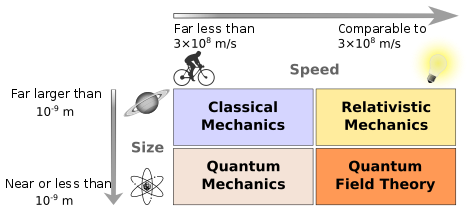
The term modern physics refers to the post-Newtonian conception of physics. Put simply, modern physics deals with the underlying structure of the smallest particles in nature ("quantum" mechanics), as well as a rigorous understanding of the fundamental interaction of particles, understood as forces. Small velocities and large distances is usually the realm of classical physics. Modern physics often involves extreme conditions; quantum effects usually involve distances comparable to atoms (roughly 10−9 m), while relativistic effects usually involve velocities comparable to the speed of light (roughly 108 m/s).

The term "modern physics" implies that classical descriptions of phenomena are lacking, and that an accurate, "modern", description of reality requires theories to incorporate elements of quantum mechanics or Einsteinian relativity, or both. In general, the term is used to refer to any branch of physics either developed in the early 20th century and onwards, or branches greatly influenced by early 20th century physics.


Read More...

Current Electricity - II

Leave a Comment
An electric current is a flow of electric charge. In electric circuits this charge is often carried by moving electrons in a wire. It can also be carried by ions in an electrolyte, or by both ions and electrons such as in a plasma.

The SI unit for measuring an electric current is the ampere, which is the flow of electric charges through a surface at the rate of one coulomb per second. Electric current can be measured using an ammeter.

Electric currents cause many effects, notably heating, but also induce magnetic fields, which are widely used for motors, inductors and generators.

A flow of positive charges gives the same electric current, and has the same effect in a circuit, as an equal flow of negative charges in the opposite direction. Since current can be the flow of either positive or negative charges, or both, a convention for the direction of current which is independent of the type of charge carriers is needed. The direction of conventional current is arbitrarily defined to be the same as the direction of the flow of positive charges.

In metals, which make up the wires and other conductors in most electrical circuits, the positive charges are immobile, and the charge carriers are electrons. Because the electrons carry negative charge, their motion in a metal conductor is in the direction opposite to that of conventional current.


Read More...

Current Electricity - I

Leave a Comment
An electric current is a flow of electric charge. In electric circuits this charge is often carried by moving electrons in a wire. It can also be carried by ions in an electrolyte, or by both ions and electrons such as in a plasma.

The SI unit for measuring an electric current is the ampere, which is the flow of electric charges through a surface at the rate of one coulomb per second. Electric current can be measured using an ammeter.

Electric currents cause many effects, notably heating, but also induce magnetic fields, which are widely used for motors, inductors and generators.

A flow of positive charges gives the same electric current, and has the same effect in a circuit, as an equal flow of negative charges in the opposite direction. Since current can be the flow of either positive or negative charges, or both, a convention for the direction of current which is independent of the type of charge carriers is needed. The direction of conventional current is arbitrarily defined to be the same as the direction of the flow of positive charges.

In metals, which make up the wires and other conductors in most electrical circuits, the positive charges are immobile, and the charge carriers are electrons. Because the electrons carry negative charge, their motion in a metal conductor is in the direction opposite to that of conventional current.


Read More...

Magnetism

Leave a Comment
Magnetism is a class of physical phenomena that includes forces exerted by magnets on other magnets. It has its origin in electric currents and the fundamental magnetic moments of elementary particles. These give rise to a magnetic field that acts on other currents and moments. All materials are influenced to some extent by a magnetic field. The strongest effect is on permanent magnets, which have persistent magnetic moments caused by ferromagnetism. Most materials do not have permanent moments. Some are attracted to a magnetic field (paramagnetism); others are repulsed by a magnetic field (diamagnetism); others have a much more complex relationship with an applied magnetic field (spin glass behavior and antiferromagnetism). Substances that are negligibly affected by magnetic fields are known as non-magnetic substances. They include copper, aluminium, gases, and plastic. Pure oxygen exhibits magnetic properties when cooled to a liquid state.

The magnetic state (or phase) of a material depends on temperature (and other variables such as pressure and the applied magnetic field) so that a material may exhibit more than one form of magnetism depending on its temperature, etc.


Read More...

Light

Leave a Comment
Light is a transverse, electromagnetic wave that can be seen by humans. The wave nature of light was first illustrated through experiments on diffraction and interference. Like all electromagnetic waves, light can travel through a vacuum. The transverse nature of light can be demonstrated through polarization.


  • In 1678, Christiaan Huygens (1629-1695) published Traité de la Lumiere, where he argued in favor of the wave nature of light. Huygens stated that an expanding sphere of light behaves as if each point on the wave front were a new source of radiation of the same frequency and phase.
  • Thomas Young (1773-1829) Augustin Fresnel (1788-1827) disproved Newton's corpuscular theory.


Read More...

Sound

Leave a Comment
Atoms and subatomic particles get disturbance in almost of all branches of physics. This disturbance is nothing but a 'wave'. We are all familiar with water waves, sound waves, light waves, radio waves and other electromagnetic waves. In this paragraph we confine our attention to waves in deformable or elastic media. These waves, among which ordinary sound waves in air are one example. They originate in the displacement of some portion of an elastic medium from its normal position, causing it to oscillate about an equilibrium
position. Because of the elastic properties of the medium, the disturbance is transmitted from one layer to the next. This disturbance (wave) consequently progress through the medium. Note that medium itself does not move as a whole along with the wave motion, the various parts of the medium oscillate. Only in limited paths. For example, in water waves, small paper pieces or a cork show that the actual motion of various parts of the water is slightly up and down and buck and forth. Yet the water waves move steadily along the water.
As they reach floating objects they set them in motion, thus transferring energy to the... Energy can be transmitted over considerable distances by wave motion. One energy in the waves is like the kinetic and potential energy of the matter, but the transmission of the energy comes about by its being passed along from one part of the matter to the next, not by any long range motion of the matter itself.


Read More...

Electro Magnetic Spectrum

Leave a Comment
The Electro Magnetic Spectrum encompasses a continuous range of frequencies or wavelengths of electro magnetic radiation, ranging from long wave length, low energy radio waves to short wavelength, high frequency, high-energy gamma rays. Frequency is defined as the number of wave cycles that pass a particular point per unit time and is commonly measured in Hertz (cycles per second), wavelength defines the distance between adjacent points of the electro magnetic wave that are in equal phase (wave crests).

German physicist Maxwell Planck proposed that atoms absorb or emit electromagnetic radiation only in certain bundles termed quanta. Albert Einstein used the term photon to describe these electromagnetic quanta. Planck determined that energy of light was proportional to its frequency ie as the frequency of light increases, so does the energy of light.

Although electromagnetic radiation is now understood as having both photon (particle) and wave-like properties, descriptions of the electromagnetic spectrum generally utilizes wave related terminology ie frequency and wavelength.

 Electromagnetic fields and photons exert forces that can excite electrons. As electrons transition between allowed orbitals, energy must be conserved. This conservation is achieved by the emission of photons when an electron moves from a higher potential orbital energy to lower potential orbital energy. Accordingly, light is emitted only at certain frequencies characteristic of every atom and molecule. Correspondingly, atoms and molecules absorb only a limited range of frequencies and wavelengths of the electromagnetic spectrum and reflect all other frequencies and wavelengths of light. These reflected frequencies and wavelengths are often the actual observed light or colours associated with an object.

Electromagnetic radiation differ significantly in their properties in their means of production and also in the way we observe then, they have certain other features in common. The following are common features.
(i) They all can be described in terms of oscillating electric (E) and magnetic fields perpendicular to each other and hence are called electromagnetic (E.M) radiation.
(ii) These electric and magnetic fields are found to oscillate perpendicular to the direction of propagation of radiation. All electromagnetic waves are transverse in nature.
(iii) All these radiations travel with the same speed, that is the speed of light (C) in vacuum. The velocity (C) in related to frequency (η) and wavelength (λ).C = ηλ = 3 × 10⁸ m/s

The waves travelling with velocity of light and consisting of oscillating electric and magnetic fields perpendicular to each other and also perpendicular to the direction of their propagation are called the electromagnetic waves. Such waves with different ranges of frequency constitute an electromagnetic spectrum.

The difference in properties of different types of E.M radiations arise only from the difference in their wavelengths (λ) or frequency (η). Therefore, the name given to particular region of electromagnetic spectrum is based on the range of its wavelengths or frequencies. The variation in the wave lengths of electromagnetic radiation is a continuous one and the various regions overlap and hence are not sharply defined. The energy of electromagnetic radiation. (ie photon) is inversely proportional to wavelength.

Read More...

Simple Harmonic Motion

Leave a Comment
Any motion that repeats itself in equal intervals of time is called periodic motion.
Examples: The spin of earth, the motion of the moon round the earth etc.,

If a particle in periodic motion moves back and forth. OVer the same path, we call the motion oscillatory or vibratory.

Eg: The oscillations of the balance wheel of a watch, a violin string, a mass attached to a spring, air molecules as a sound wave passes by.

Not only mechanical system oscillate Radio waves, microwaves and visible light are
oscillating magnetic and electric field vectors.

When the periodic motion is about a point along a straight line, it is known as Simple
Harmonic Motion (S.H.M).

Thus S.H.M is a special case of periodic motion.

Simple Harmonic Motion (S.H.M) is defined as the motion of a particle in a straight
line about a mean position, such that the force acting on the particle is always directed
towards that mean point and the force is proportional to the distance of the particle
from the mean position.

-->   The periodic motion of a particle is said to be SHM, if
(i) The motion of a particle is vibratory about a mean position.
(ii) The acceleration of the particle is always directed towards the mean position.
(iii) The magnitude of the acceleration (a) is directly proportional to the displacement.
(x) of the particle from its equilibrium position, that is a∝ – x

-->  Hooke's Law is a special case of a more general relation, dealing with the deformation of elastic bodies; discovered by Robert Hooke (1635-1703). It is obeyed by springs and other elastic bodies provided the deformation is not too great. Hooke's Law holds almost up to the elastic limit for many common materials.

Stress:
                           The restoring force per unit area, set up inside a body is called stress.
                             ∴ Stress = Restoring Force/ Area
                                            = Deforming Force / Area
                                            = F/A
Strain:
The ratio of change produced in the dimensions of a body by a system of forces or couples in equilibrium to its original dimensions is called strain.

Hooke's Law:
It states that the stress in a body is directly proportional to the corresponding strainwith proportionality limit.
Stress ∝ Strain
Stress = E x strain
(where E is called modulus of elasticity. Its value depends on the nature of the material, temperature and impurities)

Read More...

Dynamics

Leave a Comment
Dynamics is the branch of mechanics concerned with forces that change or produce the motion of bodies.

In ancient timer, most philosophers believed that a body moved with uniform velocity due to some external agent. They also thought that if there were no external agent the body would naturally come to rest. Galileo was the first to show that some external force was necessary to change the velocity of a body but that no external force was necessary to maintain the velocity of a body. This principle was adopted by Newton in his first law of motion.

Newton's Laws of Motion:
First Law: "Every body continues in its state of rest or of uniform motion in a straight line
unless it is acted upon by a net external force".

                           This law enables us to define inertia and force. We can conclude that if the net external force on an object is zero, the acceleration of the object is zero.

Inertia: If the net external force is zero, a body at rest continues to be at rest and a body in motion continues to move with uniform velocity. This property called inertia.

Examples:
1. When a coin placed over a card kept over a tumbler. Now, if we flip the card quickly away with a finger, the coin resting back at its original place due to inertia of rest drops into the tumbler.

2. When a person jumps out of a moving bus, leans forward in the direction of the motion of the bus, as his feet, suddenly coming in contact with the ground, are brought to rest whereas the upper position of his body continues to be in motion. This due to inertia of motion.

3. A person sitting in a bus falls backwards, when the bus starts suddenly as the lower part of his body in contact with the bus moved forward. With the bus whereas the upper position of his body tends to remain at rest.

Force: We define force as that which changes the state of rest of a body or of its uniform motion in a straight line i.e. force is that which over comes the inertia of a body.

Momentum: It is defined as the product of mass and velocity of a body.
                      ∴ Momentum = Mass × Velocity

Newton's' Second Law of Motion: The rate of change of momentum of a body is directly proportional to the impressed force and takes place in the direction of the force.
                                    ∴ F = ma
A force is that which acting on the body produces an acceleration in it.

Newton's Third Law of Motion: "For every action there is an equal and opposite reaction".
No action takes place in the absence reaction. Thus, in nature, forces always occur in pairs. One action and other reaction. The forces of action and reaction are simultaneous.

Examples:
1. If a rubber ball is striking agaist the wall, it comes back due to the reaction of the wall.
2. While rowing a boat, the water is pushed back by oars and due to reaction of water, the boat moves forward.
3. While walking, we push our foot against the ground, the ground in turn exerts an equal and opposite force.

Uniform Circular Motion: When a body is moving in a circle, with constant speed it is said to execute uniform circular motion. The velocity of the body is constantly changing as the direction of motion is undergoing change every instant of time. However the magnitude of the velocity remains constant.

consider a particle moving along a circle of radius 'r' in the anti clock-wise direction. With constant velocity 'v'. At every point on the path the linear velocity of the particle is along the tangent at the point. As show in the following diagram. Let O be the centre of the circle.
Let the particle be at A on the circle at some instant time. The line joining O and A is called the radius vector. Let the particles move from A to B in time 't' seconds. During this time interval. 't' sec the radius vector OA rotates through an angle θ, the new position of the radius vector being OB.

Then AB is the linear displacement of the particle and θ is the angular displacement.

This angular displacement is the angle described by the rotating radius vector of a body in circular motion, in a given time. Angular displacement is generally expressed in radians.

Radian is defined as the angle subtended at the centre of a circle by an arc of the circle nwhose length is equal to the radius of the circle.
l (length of arc) = r    l = rθ   one radian = 57°18'
Angular Velocity (ω):
The rate of angular displacement is known as angular velocity. Hence the angle described in one second by a rotating vector gives the angular velocity of the body. It is denoted by ω (omega).
∴ ω = θ/t
The time taken for one complete rotation is known as time period denoted by T. The angle descirbed by the radius vector for one complete revolution is 2π radians.
Hence angular velocity (ω) = 2π/T ------ (1)
Linear speed v = 2πr/T =
or v = 2π/T × r
or v = ωr (from (1))
                ∴ Linear velocity = Radius × angular velocity.

Translational and Rotational Motion:
(i)      When a body moves without rotation or vibration it is said to describe translationalmotion.

              Translational motion can be a straight line or a curve. The path need not necessarily be a straight line.

(ii)       When a body turns round a fixed axis we say the body is describing rotatory motion. The particles which are in rotatory motion, will have same angular velocity.

A body may possess both translational and rotational motions simultaneously as in the case of a bicycle wheel and earth motion round the sun.

Centripetal Acceleration:
The acceleration of a particle moving in a circle with uniform speed is always directed towards the centre of the path and is known as centripetal acceleration. a = v2/r

Centripetal Force:

The force which continuously defects a particle from its straight line path and makes it travel along a circular path is called centripetal force.

                   Centripetal force is necessary for the uniform circular motion of a body.
                   The earth moves around the sun because of gravitational force of attraction between them. The gravitational force here acts as the centripetal force.

The magnitude of the centripetal force in F = mv2/r
F = mrω2 ( v = r ω)

Eg: The domestic churner for separating butter and butter milk from curd. The churner sets the curd into rotatory motion with good speed and the lighter particles of butter collect at the churner.

Centrifuge is a machine used to separate particles of higher mass from those of lower mass in a given mixture.
Read More...

Kinematics

Leave a Comment
Kinematics is the branch of classical mechanics which describes the motion of points, bodies (objects) and systems of bodies (groups of objects) without consideration of the causes of motion. The term is the English version of A.M. Ampère's cinématique, which he constructed from the Greek κίνημα, kinema (movement, motion), derived from κινεῖν, kinein (to move).

The study of kinematics is often referred to as the geometry of motion. (See analytical dynamics for more detail on usage.)

To describe motion, kinematics studies the trajectories of points, lines and other geometric objects and their differential properties such as velocity and acceleration. Kinematics is used in astrophysics to describe the motion of celestial bodies and systems, and in mechanical engineering, robotics and biomechanics to describe the motion of systems composed of joined parts (multi-link systems) such as an engine, a robotic arm or the skeleton of the human body.

The study of kinematics can be abstracted into purely mathematical functions. For instance, rotation can be represented by elements of the unit circle in the complex plane. Other planar algebras are used to represent the shear mapping of classical motion in absolute time and space and to represent the Lorentz transformations of relativistic space and time. By using time as a parameter in geometry, mathematicians have developed a science of kinematic geometry.

The use of geometric transformations, also called rigid transformations, to describe the movement of components of a mechanical system simplifies the derivation of its equations of motion, and is central to dynamic analysis.

Kinematic analysis is the process of measuring the kinematic quantities used to describe motion. In engineering, for instance, kinematic analysis may be used to find the range of movement for a given mechanism, and, working in reverse, kinematic synthesis designs a mechanism for a desired range of motion. In addition, kinematics applies algebraic geometry to the study of the mechanical advantage of a mechanical system, or mechanism.


Read More...

Our Universe - Gravitashion

Leave a Comment
From Ancient times many scientists had shown great interest towards the sky. Most of the scientist studied the motion of celestial bodies.

     One of the most influential Greek astronomers and geographers of his time, "Ptolemy" propounded the geocentric theory in a form that prevailed for 1400 years. He made
astronomical observations from Alexandria in Egypt during the year. AD 127-41. In fact the
first observation which can date exactly was made by Ptolemy on 26 march 127. While last was made on 2nd feb 141.

             The Almagest is the earliest of Ptolemy work and gives in detail the mathematical theory
of motions. Of sun, moon and planets. Ptolemy made his most original contribution by presenting details for the motion of each of the planets. The almagest was not super seeded until a century after copernicus presented his heliocentric theory. 
        
        Ptolemy first of all justifies his descriptions of the universe based on earth - centred system. It is a view of the world based on fixed earth around which the sphere of the fixed stars rotates every day, this carrying with it the sphere of the sun, moon and planets.

Nicolas Copernicus:
In 16th century AD nicolas copernicus, a polish monk was born on 19th feb 1473 and the died
on may 24, 1543

              Copernicus summerised his heliocentric theory. According to this theory, the earth and
other planets moved in perfect circles around the sun located at the centre of these circles. The earth and other planets would also rotate about their own axes while orbiting around the sum in circular orbits of different radii.

     Johannes Kepler (1571-1630) was a German mathematician, astronomer and astrologer and key figure in the 17th century scientific revolution. He was assistant to astronomer Tycho Brache. He learned both the ptolemic system and copernican system of planetary motion. He believed Copernicus at that time. He defended heliocentrism form both theoretical and theological perspective, maintaining that the sun was the principal source of motive power in the Universe.

Issac Newton:
The English physicist Issac newton (1642-1727) introduced the term "Gravity" after he saw
an apple falling on to the ground in his garden. "Gravity" is the force of attraction exerted by
the earth on an object. The moon orbits around the earth because of gravity too. Newton
later proposed that gravity too. Newton later proposed that gravity was fast a particular case
of gravitation. Every mass in the universe attracts every other mass. This is the idea of
Newton's law of Gravitation.

            Newton derived the relation in such a way that F is proportional to 'm'. because the force on a body is directly proportional to its mass by Newton's 2nd law of motion F=ma. When the earth exerts a force on the falling body, by the Newton's 3rd law of motion. The falling body exerts an equal and opposite force on the earth. Therefore the gravitational force F is proportion to both the masses of falling body and the earth, i.e., m1 and m2. The inverse
square relationship 1/r2, was justified by observing motion of the moon. Newton also observed that it is not only the earth which attracts other objects, but every object in the universe attracts every other objects and he termed such a general force as ''gravitational force". One law is known as the Universal law of gravitation".

    According to this law, the gravitational force of attraction between any two objects is
i) Directly proportional to the product of their masses.
ii) Inversely proportional to the square of the distance between them.

If the masses of any two objects are 'm1' and m2 and the separation between them is r
then the gravitation at force of attraction between them is
F alpha m1m2 ..................... (1)
F alpha 1/r2 ..................... (2)

Where 'G' is proportionality constant and known as ''Universal Gravitational Constant".
"Every body in the Universe attracts every other body with a force which is directly proportional to the product of their masses and inversely proportional to the square of distance between them. The force acts along the line joining the two bodies".

The Universal Gravitational Constant 'G':


We know that F = Gm1m2/r2


Units of G:
- In SI system units of 'F' is Newton (N)
- Units of Distance (r) is meter (m)

- Units of mass (m) is kilogram (kg)

The numerical value of 'G' is experimentally found to be 6.67 × 10⁻¹¹ Nm2Kg –2

Acceleration due to gravity:

Galileo proved, (from leaning tower of pisa experiment) that objects of different masses and sizes, when dropped simultaneously from the same height, would reach the ground at same time.
In other words when an object is dropped from some height, it experiences uniform acceleration by the gravitational pull of the earth and this acceleration does not depend on the mass of the body.
The uniform acceleration produced in a freely falling body due to the gravitational pull of the earth is known as acceleration due to gravity and denoted by letter 'g' is given by the equation g = GM/r2

          where G =Universal Gravitational Constant (6.67 × 10⁻¹¹ Nm2/kg2)
                      M =Mass of the Earth

                       r =Radius of Earth
from the equation (5) Value of g is g = 9.8 ms–2

Variation of 'g' value: At a given place on the earth 'g' is constant. However, it varies due
to the fact that the earth is not a perfect sphere and its radius 'r' is not the same at all places
on its surface. Due to flattering of the earth at the poles, 'r' is minimum and hence 'g' is
maximum at the poles. Since 'r' is maximum at the equator, the value of 'g' becomes
minimum at the equator. The value of 'g' decreases as we move upwards from the surface.
As we go deep in to the earth (mine), the value of 'g' decreases.

Gravity meters: The instrument used to measure small changes in the value of 'g' at a given
location is known as gravity meters. The Boldien gravity meter and Gulf gravity meters are
two examples of gravity meter.

Mass and weight: The mass of a body is the quantity of matter contained in it. Mass is
independent of external factors like position and surroundings. Thus the mass of a given
body will be same at all place of earth or any where in the University.

                   The weight of a body is the force with which it is attracted by the earth towards its centre and is equal to the product of its mass and acceleration due to gravity.

          Thus w = mg, where 'm' is mass of body and 'g' is the acceleration due to gravity.

Since the value of 'g' changes from place to place, the weight of a given body differs from one place to another. For example: The acceleration due to gravity on moon is 1/6th of the acceleration due to gravity on earth, hence the weight of the body on moon is 1/6th of its

weight on earth.


Very Short Answer Questions

1. What is Geocentric theory?
- The earth is stationary and is at the centre of the universe, with the sun, the moon, planets and stars revolving the earth.

2. What is Heliocentric theory?
- All the planets revolve in a perfect circle with the stationary sun at the centre of these circles.

3. What is acceleration due to gravity?
A- 1.The Uniform acceleration produced in a freely falling body due to gravitational pull of the earth is called acceleration due to gravity.

      2. It is denoted by (g)

4. Define the mass of a body?
- The total quantity of matter contained in a body is defined as its mass.

5. Define the weight of a body.
- The weight of a body is the force with which it is pulled by the earth towards its centre.

6. State Hooke's law?
- According to Hooke's law "Stress is directly proportional to strain when a body is in elastic limit''.

7. Calculate the gravitational force on a stone of mass 10kg?
- Acceleration due to gravity (g) = 9.8m/sec2
   mass of the stone, m=10kg
   The gravitational force on the stone,
    F = mg = 10 × 9.8 = 98 newton.

8. Define 1 kg wt?

A- The gravitational force acting on a body of mass 1kg is called 1kg wt


SHORT
ANSWER QUESTION

1. State the Universal law of gravitation? and calculate the gravitational force of
stone of mass. 10kg.
- Newton's Universal law of gravitation states ''that every body in the universe attracts every other body with a force which is directly proportional to the product of their masses and inversely proportional to the square of the distance between them"

Problem: We know that F = mg
                                          = F = 10 × 9.8 = 98 N

2. What are the various factors that effect on the value of acceleration due to gravity (g)?
- The various factors that influence the value of 'g' are
         1. Shape of the earth
              a) At poles
              b) At equator
         2. Height (Altitude)
         3. Depth
         4. Local Conditions

3. Why is the weight of a body not the same at poles and equator?
- The weight of a body W=mg. So it depends on acceleration due to gravity. It is directly proportional to acceleration due to gravity. As the acceleration due to gravity is not same at the poles and equator, the weight of a body is also not the same at the poles and the Equator.

4. Why does the weight of a body differs from one place to another place?
- The weight of a body w=mg. It means the weight of a body is directly proportional acceleration due to gravity. As the value of acceleration due to gravity 'g' changes from place to place, the weight of a body also changes from place to place.

5. What is gravity meter? Give examples?
1. The value of g at a given location is slightly affected by geological deposits concentration of massive concrete building and topography of the region
2. So,a sensitive instrument is used to measure such small changes in the value of g at a given location.
3. This instrument is called gravity meter.
4. Examples: Gulf gravity meter and Boliden gravity meter.

Read More...